
TL;DR
The ecommerce evolution underway in 2026 is no longer a single channel. It is three fronts moving at once: discovery is shifting to AI search, decisions are moving into conversational concierges, and purchases are happening inside social feeds and live streams. Gartner estimates 60% of retail transactions will involve at least one conversational AI interaction. The brands that win treat all three as one connected system built on structured data and embedded checkout.
Introduction
Walmart embedded ChatGPT-based assistants in its app and basket size rose 14%. Taobao Live sold $7.5 billion in 30 minutes. Forty-three percent of Gen Z now start a product search on TikTok, not Google. These are not three trends. They are three symptoms of one shift: the buying journey has left your website. Customers now discover, decide, and buy across surfaces you do not own, mediated by AI you do not control. Most retailers are responding with three disconnected projects, one per team. That is the expensive mistake. Discovery, conversation, and social buying are now a single system, and the brands treating them that way are pulling away from the ones who are not.

The Ecommerce Evolution Splits Into Three Fronts
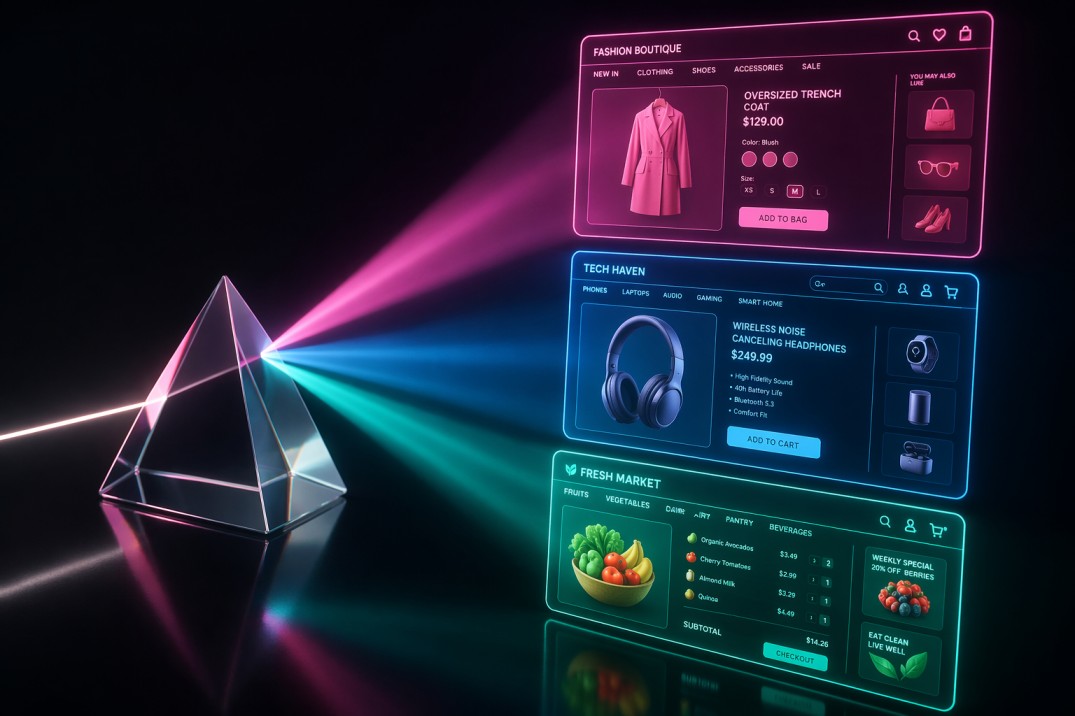
The ecommerce evolution of 2026 splits into three fronts that together replace the old funnel, a structure worth naming the Three-Front AI Commerce Model: Discovery, Concierge, and Community. Each front is a place the customer now lives, and each runs on AI rather than a static page.
- Front 1, Discovery: How customers find products. AI search, visual search, and agent-led discovery are replacing the keyword box.
- Front 2, Concierge: How customers decide. Conversational assistants interpret intent, compare options, and complete the purchase inside a dialogue.
- Front 3, Community: How customers buy. Social feeds and live streams collapse discovery, demonstration, and checkout into a single shoppable moment.
The model matters because most retailers invest in one front and ignore the other two. The customer uses all three in a single journey. A shopper might discover a product through an AI answer, refine the choice with a concierge, and buy it during a live stream that night. Win one front, lose the customer at the next.
Front 1: Intelligent search and product discovery
Product discovery is moving from keyword matching to inferred intent, images, and autonomous agents. Nearly half of Americans say AI recommendations already shape what they buy, and 64% will purchase an item a generative AI tool suggests. Traditional search volume is projected to drop 25% as AI-generated answers replace link lists, and AI search is expected to overtake conventional search by 2028. The mechanics changed underneath. A shopper uploads a photo and finds the closest catalog match. Another describes a need in plain language and gets a curated set, not a results page.
None of this rewards keyword density. It rewards structured, machine-readable product data. The Schema.org product vocabulary and Google’s structured data documentation are no longer technical hygiene. They are the difference between appearing in an AI answer and being skipped. The contrarian truth here: the brand with the best content is losing to the brand with the best structured data, because an AI model cannot recommend a product it cannot parse.
Front 2: AI shopping concierges
An AI shopping concierge is a conversational system that handles discovery, comparison, checkout, and post-purchase support inside one interface. Walmart’s deployment lifted average basket size 14% and customer satisfaction 22%. The financial case is already proven. Advanced personalization tied to conversational commerce delivers 25% to 35% higher conversion, 20% larger average order value, and 30% better retention, per McKinsey figures cited across the industry.
Conversational checkout cuts cart abandonment by 27%, according to Forrester, because the customer never leaves the dialogue to pay. The concierge succeeds across three layers: retrieval, the ability to find the right product from a vague request; transaction, the ability to close the sale in-conversation; and delegation, the trust required to let the agent act on the customer’s behalf. Most retailers build only the first. The revenue sits in the second and third. Teams like WPRiders see the same pattern repeatedly: the conversational front end ships fast, then the transaction and delegation layers stall because the underlying data and architecture were never built to support them.
Front 3: Social commerce and live shopping
Social commerce and live shopping turn feeds and streams into full-funnel sales floors. Fifty-three percent of all shoppers, and 76% of Gen Z, now discover products on social platforms. United States social commerce is projected to surpass $137 billion by 2028, and the global market is forecast to reach $6.2 trillion by 2030. Live commerce is the sharper edge. Well-executed live streams convert up to 10 times higher than standard product pages, and live commerce is expected to make up 10% to 20% of all ecommerce sales by 2026. The discipline separates winners from posters.
A live commerce event is a show, not a clip: it needs a goal, a host, pre-event promotion, and frictionless in-stream checkout. The 10x advantage evaporates the moment a viewer has to leave the stream to pay. That makes live commerce an operations and integration problem, not a creative one, and it is why AR try-ons and live demos only pay off once the checkout flow is embedded with zero handoffs.
What all three fronts demand: one foundation
The three fronts of AI commerce share a single foundation, and that is where retailers should invest first. All three depend on the same three things. First, structured, agent-readable product data, because AI search, concierges, and social feeds all read machine-readable attributes, not marketing prose. Second, embedded checkout, because every front loses its conversion advantage the instant the customer is bounced to a separate cart. Third, disclosed trust, because 68% of shoppers want to know when they are interacting with AI, and a privacy-first architecture is the precondition for letting an agent transact on someone’s behalf. Speed binds it together.
AI search, concierge replies, and live streams all collapse when performance lags, which is why an AI-native foundation matters more than any single front-end tool. In our work with commerce clients, this shared foundation, not the flashiest front-end feature, is what determines whether any of the three fronts actually convert. Use this rule to prioritize: complex, high-margin catalogs should build a concierge and win discovery first; visual and impulse categories should lead with social and live commerce; commodity and replenishment goods should focus on agent-readable feeds and skip live entirely. Everyone exposes structured data, because that is the price of being visible on any front. The same multimodal layer of voice, text, and image now runs across all three.

Key Takeaways
- AI commerce in 2026 splits into three fronts: Discovery through AI search, decisions through conversational concierges, and purchases through social and live commerce.
- Gartner estimates 60% of retail transactions will involve at least one conversational AI interaction by 2026, making AI a structural part of the buying journey.
- Traditional search volume is projected to drop 25% as AI answers replace link lists, and AI search is expected to overtake conventional search by 2028.
- An AI shopping concierge succeeds across three layers, retrieval, transaction, and delegation, but most retailers build only the first while the revenue sits in the other two.
- Well-executed live streams convert up to 10 times higher than standard product pages, and live commerce is projected to reach 10% to 20% of all ecommerce sales by 2026.
- Structured product data is the new ranking factor across every front, because AI search, concierges, and social feeds cannot surface a product they cannot parse.
- The three fronts share one foundation: structured agent-readable data, embedded checkout, and disclosed trust, which is where retailers should invest before buying front-end tools.
Conclusion
The retailers still running discovery, conversational commerce, and social selling as three separate projects will keep paying three times for the same missing foundation. The buying journey no longer respects those internal boundaries. A customer crosses all three fronts in a single afternoon, and a weak link anywhere loses the sale to a competitor whose data, checkout, and trust layer hold together. The advantage in 2026 belongs to brands that build the shared foundation once and let it serve every front. Partnering with a team that understands both WordPress commerce and AI search architecture is how most brands assemble that foundation before the journey leaves them behind entirely.
FAQs
Q1. What is AI commerce?
AI commerce is the use of artificial intelligence across the buying journey, spanning product discovery, purchase decisions, and checkout. In 2026 it operates on three fronts: AI-driven search and discovery, conversational shopping concierges, and social and live commerce. Rather than a single channel, AI commerce is a connected system where customers move fluidly between AI-mediated surfaces to find, decide on, and buy products.
Q2. How is AI changing product discovery?
AI is shifting product discovery from keyword matching to inferred intent, image search, and autonomous agents. Nearly half of Americans say AI recommendations shape what they buy, and traditional search volume is projected to drop 25% as AI answers replace link lists. Discovery now rewards structured, machine-readable product data over keyword-optimized content, because AI systems cannot surface a product they cannot parse.
Q3. What is an AI shopping concierge?
An AI shopping concierge is a conversational system that guides a customer through discovery, comparison, checkout, and post-purchase support inside one interface. It interprets natural-language requests, recommends products, completes the transaction, and handles returns. Walmart’s deployment lifted basket size 14% and satisfaction 22%. The concierge succeeds across three layers: finding the product, closing the sale, and earning trust to act on the customer’s behalf.
Q4. Why does live commerce convert better than a product page?
Live commerce converts up to 10 times higher than standard product pages because real-time demonstration, live question answering, and time-limited offers compress the decision. A host removes doubt instantly by showing the product in use. The advantage depends entirely on embedded checkout, because requiring a viewer to leave the stream to pay erases most of the gain that live interaction creates.
Q5. Where should a retailer invest first in AI commerce?
A retailer should invest first in the shared foundation that all three fronts require: structured agent-readable product data, embedded checkout, and disclosed AI trust. Complex, high-margin catalogs should then prioritize a concierge and discovery; visual and impulse categories should lead with social and live commerce; commodity goods should focus on agent-readable feeds. Front-end tools come after the foundation, not before.